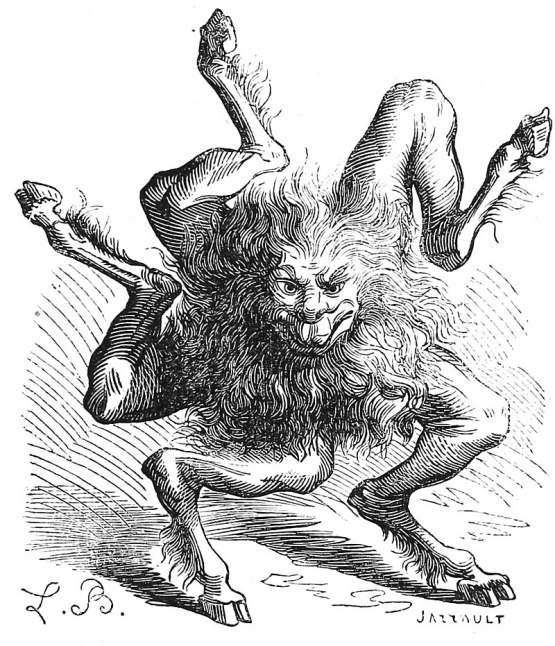
Despite the name, these demons have nothing to do with King Solomon of the Bible. They are supernatural beings listed in a spellbook known as The Lesser Key of Solomon, or Salomonis Regis, which contains descriptions of them along with summoning instructions. This meaty tome is divided into five parts, compiled by an anonymous author from a series of earlier, more ancient works, some of which date all the way back to Biblical times.
I first encountered these creatures in a book of demonology my older brother gave me on my 10th birthday. That’s right, my older brother gave me an encyclopedia of demons when I turned ten. (My mother said not a peep about it.) It was the first time I saw the bizarre illustrations of them by Louis Breton, who created the sun-lion creature above with the multiple goat legs. Known as Buer, he remains the most distinctive of this artist’s creations.

He also did this one of Caacrinolas, who looks like a demented, grinning Lhasa Apso dog.
For all my research, it’s still unclear who the actual artist was: Breton, who specialized in maritime paintings, or the mysterious M. Jarrault, who may have been an engraver. Publications back then relied heavily on engravers for their illustrations, as the photoprinting process had yet to be invented. An engraver could put his own spin on the artist he copied, and vice versa. There’s certainly a playful, satirical feel to these depictions that reminds me of John Tenniel’s illustrations for Alice in Wonderland. Tenniel intended some of them as caricatures of political figures of the time, and this pic of Baal, for example, certainly seems like an actual person.
The illustrations were made for a 1863 edition of Dictionnaire Infernal by Collin de Plancy, not The Lesser Key of Solomon itself. But because they were the first depictions of the demons, they became the ones most associated with them. There have been other depictions over the years, and perhaps I’ll do a later post on them.
My second exposure to the demons was through my uncle. He was fond of dumpster-diving, and a particular spot at a nearby mall proved fruitful. A stationary store there would tear the front covers off its unsold books, as was standard at the time, to send them back to the distributor, and toss the interiors. I was exposed to many different books that way I wouldn’t have ordinarily read. One of them was Luba Sevarg’s The Do-It-Yourself Witchcraft Guide, without the sensational cover of course.

Much of Sevarg’s book was cribbed from the Salomonis Regis and that included the list of demons. I remember one demon in particular called Pual, described as appearing as an ash tree, who could grant the caster beautiful teeth.

The various sigils of Solomon’s Demons (click to see larger)
The would-be summoner was to draw the demon’s sigil on the floor along with offerings which included colored candles. The lack of colored candles — most in the stores were white or ivory — meant I could not try the spells myself. This didn’t stop me from scribbling the runes on my school notebooks though. Although I never summoned any demons this early exposure would influence the magic systems I created later in my own writing.
The demons themselves have origins that are Greek, Hebrew, Arabic, Sumerian, and Assyrian. Like beings in a trading card game they are assigned rankings (Prince, Duke, Marquise, etc.), cardinal directions, allies they can draw upon, and spheres of influence. Hey! They may have been the first Pokemon.
The names vary from work to work, changing in translation, but all have a Latin or Greek feel. Using this, I came up with a list of my own.
New Solomon’s Demons
| Satyros
Enpan
Jozeo
Furfara
Marans
Elefantes
Vorlona
Telos
Urdil
Urtokar
Galdoth
Malkuth
Beniziel
Ultros
Flauros
Valkurm
Flaurus |
Rakorkan
Ororo
Zorahor
Zephor
Echudemon
Meltur
Balic
Ensarans
Iolus
Forzub
Asmensyr
Vagsa
Gragos
Cimal
Valus
Feldus
Astrusion |
Visphon
Marchusan
Uvaic
Dallugos
Delrabia
Phoedus
Agara
Albea
Canu
Iphemer
Perlion
Zimal
Becas
Izala
Grisaym
Focana
Malaam |


