
Vicissitudes, by Jason deCaires Taylor
What happens to the people who Medusa turned to stone?
Do they remain conscious over millennia, as continents sink and
ocean levels rise?

Vicissitudes, by Jason deCaires Taylor
What happens to the people who Medusa turned to stone?
Do they remain conscious over millennia, as continents sink and
ocean levels rise?

Silent film actress Pola Negri (real name Apolonia Chalupec)
The first movie stars to appear were not the glamourous creatures of today. They were experimental subjects, warm bodies whose only requirement was to do what the operator of the camera told them to. They were anonymous for the most part. Some of the earliest experimenters in film, like Georges Melies, used themselves as the stars. When films began to be developed commercially, the need came for named actors and actresses the audiences could relate to. Many of them came from Vaudeville and Broadway. Others were models and dancers — men and women who knew how to project themselves, create a presence.
Then, as now, the star-making machinery made them over, giving them new names and identities. A Jewish girl from Cincinnati named Theodosia Goodman became the vampy man-eater Theda Bara. A young man from Italy with the lengthy name of Rodolfo Alfonso Raffaello Pierre Filibert Guglielmi di Valentina d’Antonguella became hearthrob Rudolph Valentino. Star names back then were required to be easy to spell and say, and also easy to read, as many in the U.S. still never made it beyond grade school. They also had to be of the era. While some 1920s names like Rose and Violet have come full circle and made it back into style, others, like Ira and Blanche, have not.
Some randomly generated names if you need to create your own silent film star, or someone from the 1910s – 1920s in general.
| Female
Pearl Bold Rumor Grayson Olive May Violet Aster Stella St. Pierre Emeline LaCroix Chloe Sweet Rose Blythe Vera Hunter Odile Gracille Trudy Farthing Blanche Valentine Irene Swan Thelma Lawshe Mabel Reese Nola York Nellie Angel Mae Summers Dolores Radnor Tessie True Fanny Rivers Irene Coronet Zora Gray |
Male
Rudolf Sands Ira Hanover Miles Blair Julian Stanhope William Swain Oscar Knight Gardner Perry Dudley Cross Reuben Carlyle Victor Knightsbridge Renton Cross Paul Adler Fredrick Bynes Glen Downs Leon Bakshi Maurice Hunter Owen Nestor Boris Ostrov Simon Valentine Ramon Silva Henry Stewart Oran Rich Chick Toth |

by Katrina van Grouw
Princeton University Press, 2018
How does evolution happen? This is the behind Unnatural Selection, written by natural history curator and illustrator Katrina van Grouw. She approaches it from a direction unfashionable these days, though one that Charles Darwin received inspiration from: the selective breeding of domesticated animals. Unnatural Selection is a book about the skeletons of dogs and cats, pigeons and ducks, compared and contrasted with each other, and if you think one chicken breed, say, is much the same as another, their bones tell a different story.

Pigeon Diversity, (c) Katrina van Grouw
In addition to the mouth-watering pencil illustrations (dark graphite on rich, toothy paper, loose enough to display character, yet tight enough for scientific accuracy) there are stories about genetics, scientists of the past, anthropology, and the breeds themselves. Take, for example, the tale of the crested chicken. Some chicken breeds, such as Polish, sport a ruff of feathers on top of their heads. Unusual, but no big deal; there are plenty of birds with crests. But what lies beneath that feather cap, that’s a different story. There’s a hole in the skull, a fatty pad, and sometimes extrusions of bone sticking out of that pad, and the feathers themselves don’t belong to the head, they are those of the tail. It’s a mutation of more than a few feathers growing where they shouldn’t. The unasked question is, how does a single mutation start a cascade of effects to create the hole, the pad, the horns, the foreign feathers?
It sounded to me like the genes that grow feathers on the bird’s fatty rump somehow triggered the same growth on the head – an error of placement and developmental timing. Such a mutation, the book suggests, could have created a new race of horned and frilled chickens, if they found the right environment and were allowed to expand within it, becoming, in short time, a new species. Evolution may move by leaps as well as gradual adaptations, and if the book is firm on anything it’s that genetics isn’t always neat and tidy and doesn’t always follow the rules. Creature and environment work in conjunction with each other. If there is some environmental advantage for the chicken to have this odd headgear, it will survive and perpetuate. Or, perhaps not, but the genes are still there, waiting for their moment. It’s only a matter of time before they pop out again.
As a book about a specific branch of hard science Unnatural Selection was too anecdotal, but as a series of essays continuing on each other, it worked well and for me filled in some of the gaps from my more convention reading in genetics (I cannot recommend She Has Her Mother’s Laugh, by Carl Zimmer, highly enough.)

by Paul Koudounaris
Thames & Hudson, 2013
Heavenly Bodies, in contrast, is a book about human bones and an overlooked era of history – post-Reformation in the Germanic nations of Europe.
Catholics there were still reeling from the influence of Martin Luther and so, to bolster up the people’s faith, the Vatican decided to ship, wholesale, skeletons of Christian martyrs – or what they assumed were Christian martyrs – from a recently discovered catacomb near Rome to churches, parishes, monasteries and convents for veneration and display. These skeletons were revered as much as those of the saints were, for in the violence of the Reformation many churches had been looted and their relics destroyed. These “martyrs” filled in a vital gap for the community. As their identities were never known they were given new names and histories and received a lengthy treatment to render them as objects of display – cleaning, articulation, and sumptuous clothing. The bare bones were decorated with elaborate whorls of gems both real and glass, held in place with gold or silver wirework. Finally they were given positions of honor in the church in lifelike poses.

Such a display may seem macabre or horrifying to the people of today. Yet it was very natural to the people of the time. The bones were meant to evoke awe and faith, and even generated a vital sense of community. The author is clear-eyed and articulate, approaching the skeletons sympathetically while acknowledging their dubious exhumations. In fact, he dedicates the book to the anonymous artists behind the skeletons’ creation, for they are indeed works of art. The book is filled with sumptuous photographs of the detail involved and the effect they created in their environment, the churches. Sadly, some languish today out of the public eye, moldering in attics or warehouses.
Heavenly Bodies has a gothic, baroque vibe, but I wouldn’t call it a horror book. The emphasis was on life, not death. The skeletons, as macabre as they were, were an affirmation of faith and hope, like the painted clay muerto figurines of the Mexican Day of the Dead. The Mexican caricaturist Posada endowed them with a bizarreness that hipsters adopted with irony; recent depictions in American culture are more decorative. But in actuality the muertos are not meant with irony or a love of death. They are closer in spirit to the jeweled skeletons of those German churches. One is sanctified, the other folk; yet both arise from faith.
In all, two very good books combining both art and science, and recommended.

And everything else, for that matter.

by Patti Smith
Alfred A. Knopf, 2015
I read this book as a challenge for Seattle Public Library. Every summer they have a book bingo game, and if you fill in a row of five (the center square is free) you are entered in a contest. Each square is for a book of a different topic or genre: Fiction, Science, Bookstore recommendation, etc. One of the squares was for a SAL — Seattle Arts and Lectures — speaker, which Smith will fulfill in October.
I knew of Patti Smith from her days in the NYC punk scene as a singer, songwriter, and poet. Back then I had something of a girlcrush on her… in the first picture I ever saw of her, I thought she was a beautiful boy. I wish I looked like her, sinewy and lanky, ready to tackle anything that headed my way. I wonder if her career would have had the trajectory it did if she had been a more conventionally feminine rock artist like Ann or Nancy Wilson of Heart, or, in the punk world, a vampish Siouxsie Sioux. It seemed to me she got more respect and less catcalling being androgynous.
The introduction states M Train is a book about nothing, but in actuality it covers a year in her in life – 2012 to be exact, skipping periodically to the past and then back to the present. It is structured around the notion of a café, a place where a writer can sit and drink coffee and watch the world go by, as Smith does at her local coffeehouse, Café ‘Ino. She is there on the book’s cover, sitting in her favorite spot. The book is also about her two homes, New York City and Michigan, and travels and sojourns and friends. Not quite a memoir, more a series of reminisces. Smith has a way with the English language, using words as rhythm the way a poet at an open mike might, and I liked it much more than I thought I would.
Some of her tales are heartbreaking, like the sudden death of her husband, Fred “Sonic” Smith, a founding member of the MC5, and then, a month later, of her brother, who had sworn to help her and her family through the grieving process. I knew Smith’s background from reading a Robert Mapplethorpe biography but not her life after the mid-1980s, and I was amazed to discover she had two kids and had raised them far from New York in a small town in Michigan. I was also amazed she had married a member of the MC5; for ages I thought her husband was G.E. Smith, the guitarist in the 1980s and 90s for the Saturday Night Live band. I don’t know how I got that notion. Though Sonic Smith does not play a large role in the book he is present in the background, and Smith does a fine job of humanizing him as well, showing that so ferocious a guitar player and youthful hellraiser also enjoyed listening to baseball games in an old wooden boat.
In addition, the book made me want to carry a notebook around and using for writings and sketches on the fly, something I had never done, and always wanted to do. I am so envious of artists who do that and wind up with books so fat they can’t close. So thanks, Patti.

by Anna Apostolou
St. Martin’s Press, 1998
[Challenge # 17: A historical of any genre. ]
I’m not a big mystery reader, but I like historicals. The two put together like this book does provided a twist on what I already enjoy and gave me a history lesson to boot, though I am well aware liberties were taken for the sake of the story.
The heroine of the book is Miriam, an assistant scribe to Alexander the Great who travels with him as part of his entourage. She is a Hebrew Jew, and this fact comes up often in her interactions with the other characters of the book and with Alexander himself. A culture clash, if you will. Miriam is, also aside from Olympias who enters later in the book, the only other independent woman in Alexander’s retinue. Her perspective is constrained, but unique. She’s not a rough and tumble urban fantasy heroine who fights with her fists. She’s a more scholarly sort, arch and detached, with a dose of good common sense. Her brother Simeon, who also serves Alexander, provides a sounding board as she puzzles out the mystery.
The story begins after Alexander lays waste to the city of Thebes. Two of the officers he left in his citadel there have been killed before his arrival, one murdered, the other staged to look like a suicide – a plunge from a tower. Alexander wants justice for the murders, but the truth is hard to find. To add to all this, the ghost of Odysseus is prowling around, riling up the populace; he’s a fictional character, but also a spiritual patron of the city. And then there’s a sacred grove with a group of priestesses who guard the Crown of Odysseus, which Alexander covets; it lies on a column across a pit of fire and a pit of deadly snakes. In the course of the story, that disappears, more murders are committed, and Miriam begins to believe someone wants to embarrass Alexander and cut his reputation to shreds. Is it the Persians? Or some other faction?
Now, I went in thinking “murder mystery” and “Alexander the Great” would not be compatible, but they were. I enjoyed the history part of it while the mystery drove the plot, an entertaining combo that would have been perfect for a beach read. I can’t rate the book more than three and half stars though, because it did succumb to the clichés of the genre. Miriam discovers the murderer (I had suspected who it was by an offhand comment Miriam makes halfway through the book, but no matter) and corners them while going on and on about her deductions, letting the murder nod and make clarifications, then grab a knife when Miriam’s speech is over. Who does that? Especially in a locked room. And another bit at the beginning about the power of magnetism comes back into the story later, which I predicted it would. Still, it didn’t much hamper my enjoyment of the book.
The author is a pseudonym for writer Paul C. Doherty who has also penned historical mystery series set in Medieval England and ancient Egypt; it was a shame this one was not continued. I enjoyed the characters, especially regal, petulant Olympias, who treats Alexander like the Mama’s boy he is, and even the many minor characters are rounded individuals and not mere not mere cogs in the machine. The story treated homosexuality and cross-dressing as matter-of-fact for the time; it was just another trait, and unsensationalized. The parts about walking through the destroyed city, breathing in the smoke, and the crowding and dust of Alexander’s camp, also leapt out at me, and again, I wished the series had gone on.
The book also emphasized for me the stylistic differences between English and American writing, in historical mysteries anyway. The English POV wavered, especially within the first fifty pages, and some of the writing was sort of childlike… naïve I would say. Happily the voice became more confidant as the book progressed.
If you’re looking for something different, I recommend this.

The beautiful Passaic River falls.
As far as strange names goes, the state of New Jersey takes the cake. There are towns named Loveladies and Nutley and features like the Jenny Jump Mountains and Double Trouble State Park. In fact, drive a mile in any direction and you’ll be sure to find one or more oddly named creeks, reservoirs, hills, or cities.
Many of these names came from the Unami and Munsee languages of the region’s original inhabitants, the Lenape. Though the names are cherished to those born and raised in the state they can be giggle-producing to outsiders. Consider Assunpink and Piscataway. Some have a grimdark grandeur, like Manahawken, while others, such as Ho-Ho-Kus, sound silly. But all are different, alien, and have their own unique sound and connotations. They mix, but never blend, with New Jersey’s more staid British names: Hamilton, Manchester, Monmouth. As one of the thirteen original colonies, New Jersey has plenty of both.
If you’re writing about a town, forest, river, or lake in New Jersey, here’s a list of possibilities, all randomly generated.
| Leyconk
Mattashack Hopachmung Tuncatsung Delabir Mendwar Ranshoken Nipitcong Piscatong Nescadouly Assamenick |
Nousalick
Oradink Pehoran Sussenkunk Hedekus Sickensack Hukawanna Hudekus Putconsay Monsippany Tonwawenk |
I had a parakeet growing up, and I loved the little thing. But as pets, budgerigars have their horrible side.

When they die, for example. Often suddenly and without warning. Nothing can freak out a small child like seeing a bird that had been happily chirping an hour before lying motionless on the bottom of its cage.

A budgie paper towel funeral, complete with a mourner. Very sad.

No idea if this pic is a fake. I think it is. But just imagine those two heads with their overgrown beaks having a chattering conversation with each other. Creepsville!

Then, there’s the vampire budgie. Too horrible to contemplate.

Betty Davis in What’s Happened to Baby Jane serves up a budgie salad to her disabled sibling.

And, actually, budgies as food items is very nauseating to think about, even though some native peoples of Australia relied on them for food. Here’s a row of Japanese budgie cookies complete with budgie bungholes.

Budgie sushi, even in cartoon form, is also disturbing. Eat one of those sweet little creatures? I say not!

Giant budgies swarm a room in this installation piece by artist Wakako Kawakami. What is it with budgies and Japan?

This poor budgie has a feather mutation that makes it look like a feather duster. It can’t see or fly and can barely walk. Bred for exhibitions, its life is short.
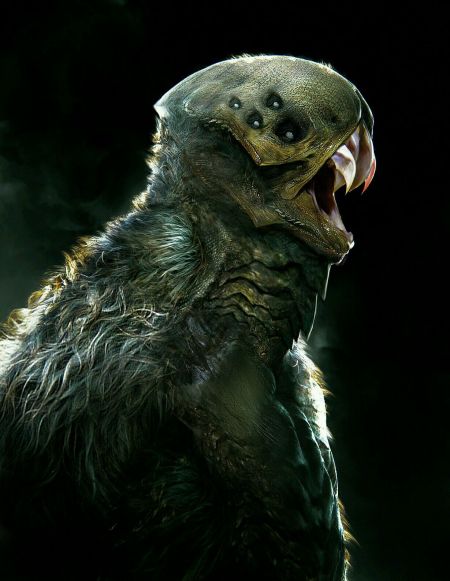
A mutant budgie that has developed into a monster in some far future when mankind is gone.

Put a dollar in my coffee jar for all
the hard work I do at Ko-fi. com!
.jpg)