Worldbuilding Wednesday 11/29/17: Imaginary Constellations

cat constellation

In a pre-industrial society, stars and constellations had more impact on the viewer because there was less light pollution. Pictures could be traced, paths, and stories, all providing a commonality among members of a tribe or society. One common example is the constellation of the Big Dipper, or Ursa Major, imagined by many ancient cultures to be an animal hunters pursued across the sky. So many, in fact, that the path of those stories has been traced from the Americas back into Asia.

Tolkien himself included the Big Dipper in his works, referring to it as The Plow.

In the Western world, constellations are a hodgepodge from different eras. The Greek period shaped our skies the most, with some, such as the creatures of the Zodiac, dating from older sources such as Babylon and Sumeria. A fresh round of constellation creation occurred in the late 1600s by Petrius Plancius, who contributed the Southern hemisphere Volans, Musca, Pavo, and others named for various flying and water creatures. In the 17th century Nicolas Louis de Lacaille and Johannes Hevelius made up some more to fill in blank spaces on the star charts. Unfortunately, instead of memorable creations like Pegasus and Sagittarius, most of these were of dull objects like Horologium (the clock) and Sextans (the Sextant.)

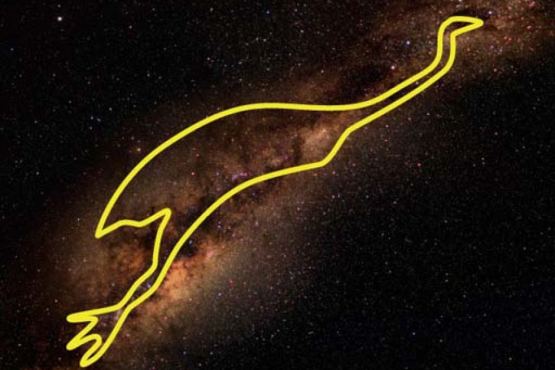
Non-Western societies had different views of the skies. Australian aboriginals formed some constellations from star absences, seeing, for example, an emu in the dark sections of the Milky Way.
Chinese cosmology had an ordered view of four divine creatures, temples, palaces, and armies.

(Click to see larger version)

The final authority on modern constellations, however, is the International Astronomical Union, and their list tops out at 88. Those constellations that didn’t make the cut include Felis, the Cat; Bufo, the Toad; Hirudo the Leech and Limax the Slug; Solarium the Sundial; and Cor Caroli Regis Martyris, or Charles’ Heart, an attempt to flatter Charles I of England.

Here’s a list of randomly generated constellations to give inspiration for your own work.


Imaginary Constellations

Karnus, the Dancing Jackel

The Celestial Ash Tree, formed by the stars Ulateuse, Tergraz, Talithtor, and Julsud

Zarra, the Manticore

The Summer Diamond

Shaunus, the Sleeping Shipwright

Phridules the Fish

The Wise Man

The Fawn-headed Acrobat

The Beetle-headed Fool

Belium the Drover

The Silent Scorpion

The Royal Staff

Alraphone, the Skybound Nightingale

The Dauntless Minstrel

Isgnorabus, the Sextant

The Golden Glaive

Charzar, the Heavenly Smelting Iron

Zenium the Crone

The Holy Quince tree

The Devil’s Bridge

Taphnus the Dogfish

Torstrixus, the Poisoned Cup

The Winter Circle

The Autumn Pentacle, consisting of the five stars Forbaran, Kandash, Gorabuel, Karlschaat and Othmal

Udales the Bat

The Weightless Ones

They are coming for you and you can’t hide from them… ever.


(Art by Alexey Andreev)

Worldbuilding Wednesday 11/22/17: Supernatural Beings


Abaraxas, a Gnostic deity

There are all sorts of fairies, elementals, grues, demons, devils, angels, nature spirits, and the like in fantasy. Often they serve a purpose in the story, and just as often they are there for window dressing, like the offhand mentions of pookas or kelpies causing trouble. In fact, things wouldn’t be the same if they weren’t there. The more bizarre, the better. Take the above character for instance: the Gnostic entity Abraxus, a rooster-headed man with snake’s legs.

Here’s a list to embolden your own work or act as inspiration.


Supernatural Beings

Ganjader: The Messenger of the Gods, a divine hawk with the head of a beautiful silver-eyed maiden.

Valkagers: Winged men who serve the gods. They have twelve eyes and stentorian voices.

Psitemph: A divine horse with silver horns and a plaintive moan when saddened.

Gongstait: A tree spirit in the form of a green ape with six arms and bulbous, bloodshot eyes.

Sorenphid: A muscular demigod with the head of a stag and tanned, brawny arms. He created the first bow, stringing it from his own forehead hair.

Zaftaloon: The demon king of centipedes. He appears in the form of a one-eyed centaur and can knowledgeably discuss alchemy and philosophy. Instead of four hooved legs, he has a hundred.

Mantiunda: Also known as the Swan Queen. In the form of a maiden she can be recognized by her white, feathered ears.

Vroleth: An arcane being that looks like a clam with the head of a camel. Sages say it created the world from a ball of its own dung.

Lion-King Theraclasp: A legendary ruler with the head of a lion and scarlet wings. He has a snowy white pelt and travels in a giant juggernaut pulled by fifty groaning slaves.

Yelwherry: A heavenly messenger with a cheetah’s head and the torso of a comely youth. On his head he bears two golden horns. Sacred writings say he farts loudly when startled.

Vampamon: A mysterious entity with the antlers of a deer, the lower body of a serpent, and hot, steaming breath.

Sulsodyne: The God of Divine Inquisition and Torture. He sends out plagues of locusts to punish infidels.

Jamposs: The Golden Hare of the Sun. He craves the taste of honey and is said to defecate when alarmed.

Sphagniron: An immortal giant with the head of an elephant. He is fond of eating spiders and has beautiful feathered wings.

The Lyphrae: A tribe of fierce warriors that wear loincloths made of catskin and cut off their own ears.

The Cult

The Cult regularly punished those who failed to recruit new members.

Worldbuilding Wednesday 11/15/17: Venice or Venus

Masquerade time in Venus (Venice)

Fantasy writing published in English-speaking worlds relies heavily on Medieval England as a setting. I suppose it’s because most early fantasy writers were, in fact, English, and then there’s the influence of the Inklings that included J. R. R. Tolkien and C. S. Lewis. It’s a heavy base that has only gotten heavier over the years. Even much of anime takes place in an English never-never land of castles, lords, and country villages. I hear enough grousing about it on social media to suggest that readers, writers, agents, and publishers are tired of it by now.

In contrast, Italian-based settings are not used as much. Historical fantasies using Renaissance Italy can be found without too much trouble, such as R. A. McAvoy’s Damiano trilogy,  but I know of only a few alternate-world Italies. There’s the city of Cittgazza in Phillip Pullman’s His Dark Materials trilogy, the Peninsula of The Hand in Guy Gavriel Kay’s Tigana, and the city of Venus in Tanith Lee’s The Secret Books of Venus quartet, based on an alternate world Venice tilted slightly askew, which is the richest of the three works. I am sure I am missing more.

Writers wanting to create a world with an Italian feel, without it actually being Italy, can use these randomly generated character names.


Alternate World Italian Names

Female

Gialladella Elanco

Lanrica Bartenzano

Belitalia Bernessa

Morlina Sante Valsaria

Violina Spinzola

Ensatra Bronerio

Candrelle Castrota

Chanitta Polifazzo

Vitterica Anneta Cerricchi

Sindelise Viparini

Elsatra Ezlisco

Stelladise Romesa

Melandrisa Barzagna

Sabrana Ilazzi

Fioria Scarese

Marghelisa Firoghi

Vittalia Montecricero

Silvria Tazasca

Denaura Rissa Fafitti

Issia d’Pomegiore

Male

Iolamo della Qualmonti

Fortipal d’Pozzio

Antonesco Ercozio

Lucisto Zapala

Terumbro Strazonti

Netasio Paprina

Darchetto Grazzietto

Fiertisto Stratziella

Fornnato Rivghetti

Olmero Firalbio

Palanzo Barbasco

Eurnetto Castroria

Bentavio Torssito

Orestopal Villaligneo

Givtonio Tellgliata

Ranchetto Sforiano

Luvino DeBonatti

Lucigi Bugcina

Givido Canobano

Lesmero Mezzadini

Black Queen VI

Black magic was one of her passions. Over time, she found the blackest.


(Artwork by menton3)

Worldbuilding Wednesday 11/8/17: Fairground Rides

So many of them sound like video games, don’t they? Probably because both are designed to take their users to a strange, disoriented world full of action and violent motion. With a dozen lists and a randomizer, here’s what I came up with, to create your own travelling carnival or Midway.


Nausea-inducing fairground rides

Hyper-Kat

Rocket Loop

Hypersteel

Techno Drive

Sky Demon

Air Chief

Devil Twirl

Sky Panic

Planet Force

Blastwave

Nitro Twirl

Devil Chief

Lunar Jam

Hyper-Vyper

Sky Attack

Magna-X

Megalactic

Lazertumble

Pop-o-Slam

Predator Holocaust

Ultradrop

Schizomania

Exojump

Voodoo Run

California Revolution

UFO Strike

Ultra Thrust

Techno Spin

Fly Master

Exo-Star

Interspin

Sky Destroyer

Aeroquin

Jet Jammer

Hyper Dragon

Crazy Twirl

Jet Spin

Skymaster

Hyperdance

Interpool

Rebel Force

Dynowave

Kinetic Drop

Interscramble

Polar Shot

Star Abyss

Quadromax

Voodoo Riptide

Ninja Twist

Double Slalom

Polar Expedition

Devil’s Empire

Tigerpillar

A little known creature from Chinese mythology, the Tigerpillar combined the ravenous appetite of both creatures.