
And everything else, for that matter.

And everything else, for that matter.

by Patti Smith
Alfred A. Knopf, 2015
I read this book as a challenge for Seattle Public Library. Every summer they have a book bingo game, and if you fill in a row of five (the center square is free) you are entered in a contest. Each square is for a book of a different topic or genre: Fiction, Science, Bookstore recommendation, etc. One of the squares was for a SAL — Seattle Arts and Lectures — speaker, which Smith will fulfill in October.
I knew of Patti Smith from her days in the NYC punk scene as a singer, songwriter, and poet. Back then I had something of a girlcrush on her… in the first picture I ever saw of her, I thought she was a beautiful boy. I wish I looked like her, sinewy and lanky, ready to tackle anything that headed my way. I wonder if her career would have had the trajectory it did if she had been a more conventionally feminine rock artist like Ann or Nancy Wilson of Heart, or, in the punk world, a vampish Siouxsie Sioux. It seemed to me she got more respect and less catcalling being androgynous.
The introduction states M Train is a book about nothing, but in actuality it covers a year in her in life – 2012 to be exact, skipping periodically to the past and then back to the present. It is structured around the notion of a café, a place where a writer can sit and drink coffee and watch the world go by, as Smith does at her local coffeehouse, Café ‘Ino. She is there on the book’s cover, sitting in her favorite spot. The book is also about her two homes, New York City and Michigan, and travels and sojourns and friends. Not quite a memoir, more a series of reminisces. Smith has a way with the English language, using words as rhythm the way a poet at an open mike might, and I liked it much more than I thought I would.
Some of her tales are heartbreaking, like the sudden death of her husband, Fred “Sonic” Smith, a founding member of the MC5, and then, a month later, of her brother, who had sworn to help her and her family through the grieving process. I knew Smith’s background from reading a Robert Mapplethorpe biography but not her life after the mid-1980s, and I was amazed to discover she had two kids and had raised them far from New York in a small town in Michigan. I was also amazed she had married a member of the MC5; for ages I thought her husband was G.E. Smith, the guitarist in the 1980s and 90s for the Saturday Night Live band. I don’t know how I got that notion. Though Sonic Smith does not play a large role in the book he is present in the background, and Smith does a fine job of humanizing him as well, showing that so ferocious a guitar player and youthful hellraiser also enjoyed listening to baseball games in an old wooden boat.
In addition, the book made me want to carry a notebook around and using for writings and sketches on the fly, something I had never done, and always wanted to do. I am so envious of artists who do that and wind up with books so fat they can’t close. So thanks, Patti.

by Anna Apostolou
St. Martin’s Press, 1998
[Challenge # 17: A historical of any genre. ]
I’m not a big mystery reader, but I like historicals. The two put together like this book does provided a twist on what I already enjoy and gave me a history lesson to boot, though I am well aware liberties were taken for the sake of the story.
The heroine of the book is Miriam, an assistant scribe to Alexander the Great who travels with him as part of his entourage. She is a Hebrew Jew, and this fact comes up often in her interactions with the other characters of the book and with Alexander himself. A culture clash, if you will. Miriam is, also aside from Olympias who enters later in the book, the only other independent woman in Alexander’s retinue. Her perspective is constrained, but unique. She’s not a rough and tumble urban fantasy heroine who fights with her fists. She’s a more scholarly sort, arch and detached, with a dose of good common sense. Her brother Simeon, who also serves Alexander, provides a sounding board as she puzzles out the mystery.
The story begins after Alexander lays waste to the city of Thebes. Two of the officers he left in his citadel there have been killed before his arrival, one murdered, the other staged to look like a suicide – a plunge from a tower. Alexander wants justice for the murders, but the truth is hard to find. To add to all this, the ghost of Odysseus is prowling around, riling up the populace; he’s a fictional character, but also a spiritual patron of the city. And then there’s a sacred grove with a group of priestesses who guard the Crown of Odysseus, which Alexander covets; it lies on a column across a pit of fire and a pit of deadly snakes. In the course of the story, that disappears, more murders are committed, and Miriam begins to believe someone wants to embarrass Alexander and cut his reputation to shreds. Is it the Persians? Or some other faction?
Now, I went in thinking “murder mystery” and “Alexander the Great” would not be compatible, but they were. I enjoyed the history part of it while the mystery drove the plot, an entertaining combo that would have been perfect for a beach read. I can’t rate the book more than three and half stars though, because it did succumb to the clichés of the genre. Miriam discovers the murderer (I had suspected who it was by an offhand comment Miriam makes halfway through the book, but no matter) and corners them while going on and on about her deductions, letting the murder nod and make clarifications, then grab a knife when Miriam’s speech is over. Who does that? Especially in a locked room. And another bit at the beginning about the power of magnetism comes back into the story later, which I predicted it would. Still, it didn’t much hamper my enjoyment of the book.
The author is a pseudonym for writer Paul C. Doherty who has also penned historical mystery series set in Medieval England and ancient Egypt; it was a shame this one was not continued. I enjoyed the characters, especially regal, petulant Olympias, who treats Alexander like the Mama’s boy he is, and even the many minor characters are rounded individuals and not mere not mere cogs in the machine. The story treated homosexuality and cross-dressing as matter-of-fact for the time; it was just another trait, and unsensationalized. The parts about walking through the destroyed city, breathing in the smoke, and the crowding and dust of Alexander’s camp, also leapt out at me, and again, I wished the series had gone on.
The book also emphasized for me the stylistic differences between English and American writing, in historical mysteries anyway. The English POV wavered, especially within the first fifty pages, and some of the writing was sort of childlike… naïve I would say. Happily the voice became more confidant as the book progressed.
If you’re looking for something different, I recommend this.

The beautiful Passaic River falls.
As far as strange names goes, the state of New Jersey takes the cake. There are towns named Loveladies and Nutley and features like the Jenny Jump Mountains and Double Trouble State Park. In fact, drive a mile in any direction and you’ll be sure to find one or more oddly named creeks, reservoirs, hills, or cities.
Many of these names came from the Unami and Munsee languages of the region’s original inhabitants, the Lenape. Though the names are cherished to those born and raised in the state they can be giggle-producing to outsiders. Consider Assunpink and Piscataway. Some have a grimdark grandeur, like Manahawken, while others, such as Ho-Ho-Kus, sound silly. But all are different, alien, and have their own unique sound and connotations. They mix, but never blend, with New Jersey’s more staid British names: Hamilton, Manchester, Monmouth. As one of the thirteen original colonies, New Jersey has plenty of both.
If you’re writing about a town, forest, river, or lake in New Jersey, here’s a list of possibilities, all randomly generated.
| Leyconk
Mattashack Hopachmung Tuncatsung Delabir Mendwar Ranshoken Nipitcong Piscatong Nescadouly Assamenick |
Nousalick
Oradink Pehoran Sussenkunk Hedekus Sickensack Hukawanna Hudekus Putconsay Monsippany Tonwawenk |
I had a parakeet growing up, and I loved the little thing. But as pets, budgerigars have their horrible side.

When they die, for example. Often suddenly and without warning. Nothing can freak out a small child like seeing a bird that had been happily chirping an hour before lying motionless on the bottom of its cage.

A budgie paper towel funeral, complete with a mourner. Very sad.

No idea if this pic is a fake. I think it is. But just imagine those two heads with their overgrown beaks having a chattering conversation with each other. Creepsville!

Then, there’s the vampire budgie. Too horrible to contemplate.

Betty Davis in What’s Happened to Baby Jane serves up a budgie salad to her disabled sibling.

And, actually, budgies as food items is very nauseating to think about, even though some native peoples of Australia relied on them for food. Here’s a row of Japanese budgie cookies complete with budgie bungholes.

Budgie sushi, even in cartoon form, is also disturbing. Eat one of those sweet little creatures? I say not!

Giant budgies swarm a room in this installation piece by artist Wakako Kawakami. What is it with budgies and Japan?

This poor budgie has a feather mutation that makes it look like a feather duster. It can’t see or fly and can barely walk. Bred for exhibitions, its life is short.
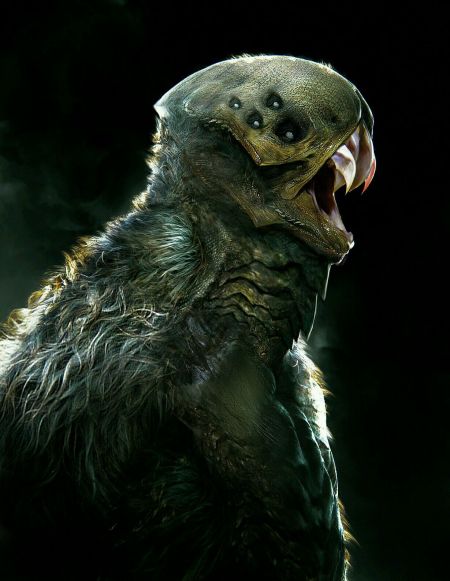
A mutant budgie that has developed into a monster in some far future when mankind is gone.

Victorian-era skeletons in a medical engraving
I’ve looked at alternate U.S. states before on this site here and here, but frankly, where things really start to get whacky is on the West Coast. But you knew that, didn’t you?

Being the most populous state in the union California tends to get divided up a lot. It seems fresh proposals come down the line every few years. Here Old California births six new baby states, rather uncreatively named. Jefferson is the oldest of these, having its origins in 1941 when some counties in southwestern Oregon joined counties of Northern California to secede from the U.S. altogether as the nation-state of Jefferson, the movement a reaction from rural communities who felt ignored by political leaders in the more urban areas.

Another way of dividing up California. Jefferson makes another appearance, and the megalopolises of San Francisco and Los Angeles each become the capitols of the new states of Reyes and San Gabriel, respectively. San Diego becomes the capitol of Cabrillo while San Joaquin retains Sacramento and the wine country of Napa Valley.
Washington state has also been proposed for a split, the land west of the Cascades retaining the name while the east becomes the new state of Columbia. In recent years Washington has been the center of a proposed ecotopia called Cascadia, which would also include Oregon, Northern California, and parts of Idaho, Montana and British Columbia. Here’s an imagining of it, flanked by the new state flags of its components.


This is actually an alternate state flag for Washington, but it would make a fine one for Cascadia as well.
Alaska, meanwhile, is too sparsely populated to be divided, as yet, but some have proposed splitting it anyway.

Oregon has been quiet regarding splitting and seceding, apart from the Jefferson business in 1941, but if the Oregon Territory had been organized differently, we might be looking at several states where present-day Oregon is. Like Washington, the most likely divide would be east-west, with the Cascade Mountains as the boundary.
If you’re looking to name an imaginary state in some imaginary U.S., and want to give it a name that evokes Washington or Alaska without it being quite like those real-world states, look no further.
| Washington
Wemmington Wallachium Weatherton Westorus Washtequan Wappinton |
Oregon
Aprophon Oregium Iregon Obregon Olegous Osatha |
California
Cosheedia Calennia Calliford Salifordia Calenquain Calamnia |
Alaska
Ulasko Anasbra Illyaska Alarko Obuska Athalaska |

Surely its name was S’phink-Ter?

Put a dollar in my coffee jar for all
the hard work I do at Ko-fi. com!