Children of Blood and Bone [Review]

Children of Blood and Bone by Tomi Adeyemi

Children of Blood and Bone

by Tomi Adeyemi
Balzer + Bray, an imprint of HarperCollins Publishers, 2015

Tomi Adeyemi’s West African fantasy Children of Blood and Bone is one of the most talked-about YA releases of 2018, scoring the author a seven figure movie deal. Reviews have been gushing, but is it worth all the hype and hopes cast upon it? Well, yes and no.

The fantasy is set in a small island kingdom reminiscent of West Africa. There’s a pantheon of gods who gifted the dark-skinned, white-haired Maji people control over the elements — death and life, health and disease, fire, air, metal, etc. with the stipulation that the powers were to be used for the good of all. But sometime in the past the ruling Maji misused their powers, and so rulership passed on to another people, the copper-skinned Koridan. The Maji continued to serve the general population, but in an uneasy standoff with the ruling house. Twelve years prior to the story’s beginning the Koridan King Saran performed a pogrom on the Maji and their priests and attempted to destroy the sacred artifacts that linked them with their gods. All their magic disappeared, and unless the artifacts are gathered back together and a ceremony performed in, like, two weeks, the magic will be gone for good. It’s a clunky backstory and more than a little graceless, which, to be frank, dulled my appetite for reading further (though I did.)

In the first chapter the heroine of the story, Zélie, is introduced, the daughter of a poor fisherman and a Maji mother known as a Reaper – one with the power of death and the ability to control souls. Initially, Zélie was a cliché – the simmering rebel whose propensity for acting before she thinks (including speaking against injustices) lands her in trouble, though it’s clear the writer wants us to laud her for it, not think of it as a personal flaw like her family does. It’s really a way to move the story along, a McGuffin, if you will. Her family is being taxed to death because King Saran wants to bankrupt and destroy the remaining de-magicked Maji. He’s not doing this arbitrarily because he’s the bad guy; his first family was killed by Maji during an attempt to reconcile the two peoples, and he decides that magic corrupts societies and must be destroyed. It’s a valid point given how the Maji met their downfall, and adds to his shading as a villain. He’s probably the most-rounded character in the book.

When Zélie, whose mother was horrifically killed in Saran’s purge, meets Princess Amari, Saran’s teenage daughter, the plot begins. Amari read like a character added later in the writing process by the author. She’s not really needed for plot to work, but in the second half of the book, she adds depth. Again, she starts out as a cliché – the princess who doesn’t want to be a princess because of the twittering tedium of court life and her expected role to play in it. When Saran kills her favorite Maji handmaiden, Amari impulsively steals one of the artifacts necessary for the Maji ceremony and runs away, a plot turn that, to me at least, seemed shoehorned in and might have been handled better. Eventually she, Zélie, and Zélie’s brother Tzain are drawn into the quest to find the other artifacts, with Amari’s older brother, Crown Prince Inan, pursuing them on the orders of the king.

The story is told in first person present. The POV hops between Zélie, Inan, and Amari, and I do mean hop; most of the chapters are short, giving a choppy, slightly seasick effect. They were labeled by each character’s name, so I wasn’t confused. But they were not very distinctive from each other, either, and they all sounded like mouthpieces for the author. A sense of verisimilitude was missing; I didn’t feel any of these three could exist outside of the book. Admittedly first person present is not my favorite voice to read. I never know who the narrator is supposed to be telling the damn story to, for one thing. The technique worked well in Simon vs. The Homo Sapiens Agenda, because Simon was telling it in stream-of-consciousness, organizing his life as he experiences it into a narrative to try to make sense of it. But in Children, as well as in Red Queen and Wither, which I’ve also read, the author seems to be using it for sweekability: hooking the reader with enough immediacy to thumb past page after virtual page on a Kindle or cell phone app, even if they’re on a bouncing bus or in a noisy classroom. This sweekable voice isn’t structured like an oral narrative that requires introspection. It’s all sharp jolts and action, and past the first three chapters I got very tired of the characters’ constant listing of their anxious tics: hands gripping staffs, teeth grinding, stomachs churning, etc. as if the reader can’t guess how they feel from the dangers of the plot they’re subjected to. It’s a common mistake for new writers, to be fair.

The first half of the book was run of the mill for a YA fantasy, or any fantasy really, only the novelty of the African-based setting making things interesting. Some parts, like the lengthy detour the quartet make to the holy city where the Maji priests once lived, might have been cut. The religion made sense as being Voudoon-based, not one with a hierarchical clergy and stiff rules about this and that, which seems more Western in nature. There’s a part there with a cut rope bridge aiding the characters’ escape, and Prince Inan ordering the bridge rebuilt to pursue them… ignoring the issue of how to get to their other side of the canyon to do that, if there’s no bridge.

But the story did pick up significantly in the middle, when Zélie discovers a hidden camp of diviners in the mountains whose magical powers are accidently activated by the artifacts. Though the encounter is cliché (the old trope where two groups who are really on the same side don’t know it because they can’t/won’t communicate properly) the ensuing tribal festival and the budding romance between the Prince Inan and Zélie make it magical. Then the action really starts when Saran sends his troops in to get the artifacts back and the prince’s loyalties are torn. At that point, the characters really began to learn and grow, and I was keen to discover how they did it. The story is resolved in a blockbuster way after a prison break and scramble to a secret island that only appears at the summer solstice where the magic ceremony must be performed.

So, 4 stars for the end, 2 1/2 for the beginning: I’ll round it out to three. Did I wish it was better? Yes. Will I be reading the next book? Yes.


The Fates’ Strange Fate

We used to be The Three Fates, until Lachesis unleashed her inner Dominatrix.


Worldbuilding Wednesday 5/23/18: Eurospy

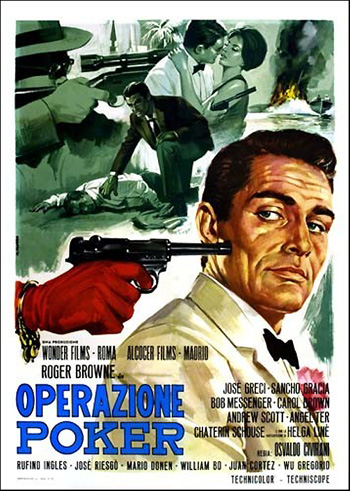
Operazione Poker, a Eurospy film

The Cold War just got hotter. Typical poster (note the Sean Connery look-alike) for a Eurospy film.

In the early 1960s James Bond was the coolest fictional character ever. He weathered life-threatening situations with humor and aplomb, handled fisticuffs as well as martinis and expensive suits, and was always able to bed beautiful women. Dr. No, released in 1964, inspired a whole trend of spy movies and parodies of spy movies, like Casino Royale (1967) and Doris Day’s The Glass Bottom Boat. Such movies drew from their cultural roots in the Cold War and rendered its very real dangers into fantasy. The U.S. had knock-off secret agents Matt Helm, Flint, and Napoleon Solo, and the Europeans a whole subgenre of cheaply produced, exploitive — and thus terribly fun — movies known collectively as Eurospy. (The Glorious Trash pulp fiction site reviews a bunch of them here.)

Characters in Eurospy films were always running from one country to another and referencing obscure Cold War people, places, and things. If you’re writing a historical thriller set in those times, a parody, or a spy spoof, here’s some randomly generated creations you can use.

Eurospy Names

FRANCE

Parembrys

Osseilles

Chegboux

Gruyrobles


RUSSIA

Kuniv

Vosdrozh

Ulskygrod

Pelyabinsk


SPAIN

Rudras

Murmad

Igoza

Palananca

ENGLAND

Wistonden

Chesscastle

Liverwood

Stousetint


NETHERLANDS

Imsverdam

Drusjfels

Untwerth

Unydhoven


CZECHOSLOVAKIA

Schagia

Vnodzka

Znojri

Plebyrny

GERMANY

Ruthenhofft

Viermaisse

Brumbergnen

Gürlin


FINLAND

Hjarinki

Sjasa

Peinajika

Soesjoki


TURKEY

Aurasymky

Issayul

Byapsari

Zamukallu

Aliens

Ecstasy of the deepest kind.

Worldbuilding Wednesday 5/16/18: Plague and Pestilence

Plague Doctor, by ChainclawofBloodClan

Many fantasies are set in a never-never-land of times gone by. Usually it’s Medieval Europe. But the Roman Empire, Bronze Age Britain, and Dynastic Egypt also get their times in the sun. All have one thing in common: the dearth of plagues. Which, admittedly, are hard to incorporate into uplifting adventure stories. They’re depressing, and tend to kill a lot of people, characters included, and thus derail plots and quests.

Diseases are easier to find as local color or plot devices. John Norman’s Gor series had a leprosy-like disease called Dar-Kosis, and Harry Potter, Dragon Pox. Grayscale features in George R. R. Martin’s A Song of Ice and Fire series.

Should you need a quaintly named disease, plague or pestilence for plot purposes, here’s a randomly generated list of them.

Plagues

The Brown Wasting

Putrid Croup

Scratchpphleg

Black Ptomordis

Grim Pox

Agfulo

Red Colic

Heartblind

Brown Scurvinia

Black Choke

Spotted Chrothenia

Sprondophy

Wheat Hives

Scarlet Twitch

Blue Septis

Crock Hives

Bulbsy

Pule Ague

Camp Death

Yellow Rot

Sprondopsy

Agenza

Laughing Boils

Black Cerewad

Dog’s Eye Effluvia

Cyanlera

Herpenza

Ditch Grippe

Dancing Parula

Screaming Spasms

Softbones

Blue Chromordis

Gringopsy

Dyspraxis

Sponge Pox

Speckled Plague

Ureacropsy

Centipede Curse

Rotting Fever

Land Flux

Thin Plague

Dragon Catarrh

Rotting Canker

Catchscrat

Scrotflora

Red Malaise

Blood Fever

Liver Cramps

Scarlet Blindness

Summer Contagion

Scrotthae

Paraenza

White Chill

Brown Cropsy

Wooden Figures

Daphne’s curse was sometimes extended to both sexes.

Worldbuilding Wednesday 5/9/18: The Wild West

I’m going to guess this cowgirl just busted her bare-chested (but chaps-wearing) boyfriend out of a Mexican jail.

Yippee-ki-yay! The Western is a uniquely American form of cinema and literature taking its plot, characters, and setting from the American Old West in the years 1850 to 1900. Cowboys (and cowgirls) ride horses, bear rifles and revolvers, and often live a nomadic life drifting through small towns, ranches, saloons, and military forts in the arid, dry landscapes west of the Rio Grande. Common themes are pursuing justice, solving crimes, or searching for treasure or missing loved ones. Westerns were popular up to the 1960s, but fell out of favor as America catapulted itself into the space age. In recent years, there’s been a resurgence as classic plots are refreshed for a more cynical and irreverent age. Steampunk, for example, draws as much from Old West style and technology as from Victorian Age England; the terribly written, but sumptuously art directed, Will Smith movie Wild Wild West, with its giant steam-powered tarantula and floofy dance-hall costumes for the villain’s henchwomen, was a seminal influence.

If you’re writing a Western but are stumped for names, here’s some you can use.

Wild West Names

COWBOYS AND COWGIRLS

Irma Wells

Pearl King

Frank Hawk

Chicken Dinner Katie

Johnny Ten Feathers

Samuel Savage

Whiskey Emmeline

One-Shot Hezekiah

Henry Carver

Hank Laplante

Two Dollar Kitty

Birdie McClancy

Rusty Savage

Dutch McMurphy

TOWNS AND SETTLEMENTS

Gypsy Well

Cokeville

Antelope Path

Horsehead City

Devil’s Mile

Sunday Skillet Junction

Cowboy Coffee

Pronghorn Nose

Dog Path

Black Hawk Township

Buzzard Foot

White Horse City

Gringo Pueblo

Mule Spirit

PLACES

Happy Papoose Ridge

Chinaman Flats

Red Elk Falls

The Devil’s Frying Pan

Thunderbird Spring

Blackbird Summit

Twenty Mile Canyon

Iron Ore Gully

Fool’s Gold Mesa

The Axe Handle Trail

Rattlesnake Heaven

Mormon Ford

Quagmire Spring

White Antelope Valley

Those Greek Kids

My, what a nice cock you have.